Imagine a world where your healthcare is tailored just for you—early disease detection, precise treatment recommendations, and round-the-clock monitoring, all powered by artificial intelligence. Sounds futuristic, right? Well, the future is here, and AI is revolutionizing how we approach patient care.
In this blog, we’ll walk you through the incredible ways AI is transforming healthcare and what it means for patients, providers, and the industry as a whole. Are you curious to learn how AI in patient care is reshaping your health journey? Let’s get started.
The rise of AI in patient care
While the underlying concepts of artificial intelligence have existed for decades, its widespread adoption in healthcare is a relatively recent phenomenon, with significant growth seen in areas like AI in patient care over the last ten years.
The early 21st century saw key advancements like increased computing power, the availability of large datasets ("Big Data"), and improved AI algorithms, laying the groundwork for AI's integration into medical practices.

The true turning point, however, was the growing recognition of AI's potential to directly address critical challenges in patient care, from improving diagnostic accuracy and personalizing treatments to streamlining healthcare operations.
According to Statista, the market, valued at $11 billion in 2021, is projected to reach an impressive $187 billion by 2030. This increasing impact is reflected in the rapid growth of the AI healthcare market, demonstrating a clear trend toward greater AI integration across the healthcare industry.
Different types of artificial intelligence in patient care
Artificial intelligence is transforming patient care through various AI in patient care approaches, each with unique strengths:
Machine learning for personalized treatment
Machine learning algorithms analyze vast amounts of patient data, including medical records, imaging, and vital signs, to provide precise diagnoses and customized treatment plans.
This personalized approach, precision medicine, allows healthcare professionals to tailor interventions to individual patient needs, leading to more effective and targeted care.
Deep learning, a subset of machine learning, further enhances these capabilities, enabling more sophisticated analysis and prediction.
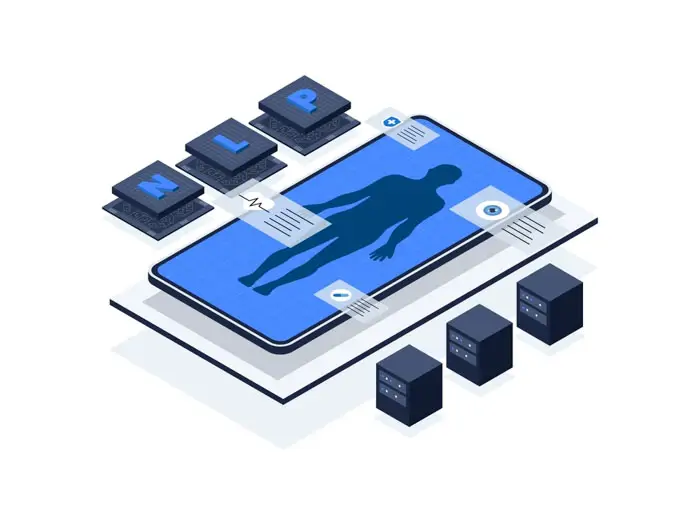
Natural language processing (NLP)
NLP empowers computers to understand and process human language, enhancing patient care in several ways.
NLP can analyze medical records to extract key information for more accurate diagnoses, identify relevant treatments and medications, and predict potential health risks based on patient history.
Additionally, NLP facilitates better patient-provider communication through chatbots and virtual assistants, providing readily accessible information and support.
AI-Powered Clinical Decision Support
While early rule-based expert systems faced limitations in scalability and integration, they laid the foundation for modern AI-powered clinical decision support systems.
These systems assist healthcare professionals in making informed decisions at the point of care by providing evidence-based recommendations, flagging potential drug interactions, and alerting clinicians to critical changes in patient status.
AI's impact on diagnosis and treatment
AI-driven platforms are enhancing diagnostic accuracy and creating personalized treatment plans. AI systems analyze clinical data and diagnostic images to provide reliable second opinions while also synthesizing patient data and research findings to craft treatment regimens tailored to individual needs.
However, these systems often face challenges in integrating with existing EHRs and clinical workflows, requiring healthcare providers to invest in interoperability solutions for seamless implementation.
Streamlining administrative tasks
AI is also revolutionizing administrative processes in healthcare, automating tasks such as data entry, claims processing, and appointment scheduling.
This automation frees up valuable time for healthcare professionals to focus on direct patient care, improving efficiency, and enhancing the patient experience.
Examples of AI in patient care
To illustrate AI's transformative impact on patient care, here are several key examples:
AI-enhanced medical diagnosis
Diagnostic errors contribute significantly to preventable harm in hospitals. AI offers a powerful solution by analyzing medical images, patient records, and other data to provide more accurate and timely diagnoses.
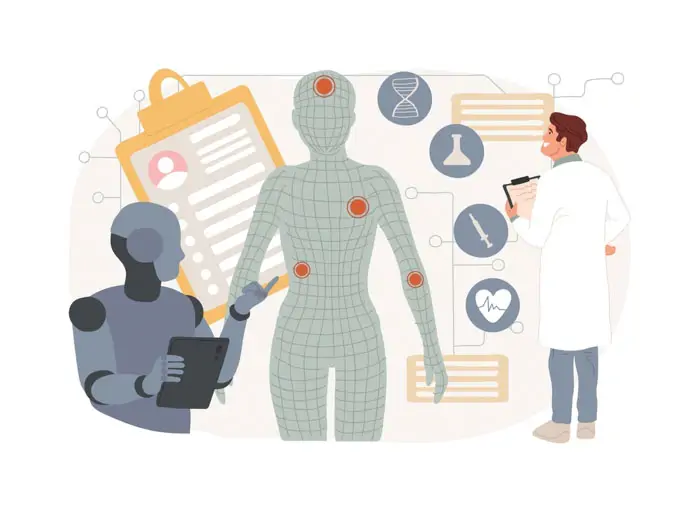
This improved diagnostic accuracy directly translates to better patient outcomes by enabling faster and more appropriate treatment.
AI accelerating drug discovery
The traditional drug development process is lengthy and expensive. AI is accelerating this process by assisting in drug design, predicting side effects, and identifying suitable candidates for clinical trials.
By reducing the time and cost associated with bringing new drugs to market, AI ensures patients have faster access to potentially life-saving treatments.
AI-driven patient experience
AI is enhancing the patient experience through various applications. AI-powered chatbots provide convenient access to information and support, while personalized health tips and appointment reminders help patients actively manage their health.
Furthermore, AI-assisted diagnosis and treatment planning contribute to faster and more personalized patient visits, improving satisfaction and overall care quality.
AI-powered data management
The sheer volume of healthcare data can be overwhelming. AI's ability to process and analyze massive datasets unlocks valuable insights that can directly impact patient care.
By connecting disparate data points, AI in patient care facilitates faster development of new treatments and preventive strategies and enables more accurate and timely diagnosis.

AI in robotic surgery
AI-assisted robotic surgery enhances surgical precision and control, leading to minimally invasive procedures, reduced complications, less pain, and faster recovery times for patients.
This technology translates directly to improved patient outcomes and a better surgical experience.
Advantages of AI in patient care
AI in patient care offers practical solutions that address key challenges in healthcare and directly improve patient care in several ways:
Faster and more accurate diagnoses
By streamlining diagnostic workflows, AI enables faster and more accurate diagnoses. AI algorithms assist radiologists in analyzing medical images, allowing care teams to prioritize urgent cases and potentially detect subtle issues that might otherwise be missed. This leads to quicker treatment initiation and better patient outcomes.
Reduce staff retention
AI automates time-consuming administrative tasks, such as data entry and prior authorization requests.
This automation alleviates employee burnout and frees up clinicians to dedicate more time to direct patient interaction, leading to improved patient satisfaction and a more personalized care experience.

Earlier disease detection
AI tools play a crucial role in early disease detection, significantly impacting disease progression and patient prognosis.
By analyzing patient data and identifying subtle patterns, AI in patient care can support earlier identification of chronic conditions like chronic kidney disease, allowing for timely interventions that can slow, prevent, or even stop disease progression.
Optimized and personalized treatments
AI accelerates the development of new drugs and optimizes existing treatment strategies. By analyzing vast amounts of data, including genetic information and medical histories, AI algorithms can help identify high-potential drug candidates, predict their effectiveness and safety, and inform personalized treatment plans tailored to individual patient needs.
This results in more effective treatments and reduces the risk of adverse effects, directly improving patient outcomes.
Disadvantages of AI in patient care
While AI offers significant potential to improve patient care, several key challenges must be addressed to ensure its safe and effective implementation:
Patient privacy and data security
AI systems in healthcare rely on vast amounts of sensitive patient data. Protecting this data from unauthorized access and misuse is paramount. Robust security measures and strict adherence to privacy regulations (like HIPAA) are essential to maintain patient trust and prevent potential harm from data breaches.
Patient safety and diagnostic accuracy concerns
The accuracy and reliability of AI-driven diagnoses and treatment recommendations are crucial concerns for patient safety.
AI algorithms must be rigorously trained on diverse and representative datasets to ensure they can accurately recognize patterns in medical data and provide appropriate recommendations tailored to individual patient needs.

Inaccurate or biased AI systems can lead to misdiagnosis or inappropriate treatments, potentially jeopardizing patient health.
Integration issues with existing healthcare systems
Integrating AI tools with existing IT infrastructure, such as EHRs, is essential for seamless data flow and effective use of AI in patient care.
Integration challenges can disrupt workflows, create data silos, and hinder the ability of healthcare professionals to access and utilize AI-generated insights effectively.
Building trust and ensuring ethical ai use
Gaining the trust of healthcare professionals is critical for the successful adoption of AI in patient care. Physicians and other clinicians need transparency into how AI systems make decisions to ensure they are based on valid medical research and ethical principles.
Furthermore, adherence to federal regulations is crucial to guarantee that AI is used ethically and responsibly, prioritizing patient safety and well-being.
The future of AI in patient care
AI is poised to revolutionize patient care, transforming how clinicians diagnose, treat, and manage health in the coming years. Several key advancements will directly impact patient experiences and outcomes:
Proactive and personalized care
AI tools will enable more proactive and personalized care by predicting disease progression through subtle signals in patient data. This allows for earlier interventions, potentially preventing serious health events and improving long-term outcomes for patients.
Enhanced surgical care and remote access
AI will enhance surgical care through real-time remote assistance and collaboration. Advanced platforms will enable specialists to virtually guide procedures in resource-limited settings, expanding access to high-quality surgical expertise for patients in underserved areas.
AI will also help reduce alarm fatigue for surgical teams, ensuring focus on critical events and improving patient safety during procedures.

Continuous patient monitoring and personalized treatment plans
AI-driven wearable technology will enhance remote patient monitoring, allowing clinicians to continuously track patient well-being and respond promptly to any concerning changes.
AI in patient care will also drive advancements in precision medicine by streamlining the interpretation of genetic and genomic data, enabling faster diagnoses and truly personalized treatment plans tailored to individual patient needs.
Streamlined processes and virtual support
AI will streamline administrative tasks such as insurance approvals and billing, reducing red tape and waiting times for patients.
Furthermore, AI-powered virtual health coaches will provide personalized guidance on lifestyle choices, supporting preventive care and empowering patients to actively manage their health.
AI will also aid in the early detection of rare diseases, leading to faster diagnosis and treatment for patients with these challenging conditions.
The importance of human-ai collaboration
While AI offers tremendous potential, integrating these tools into everyday clinical practice remains a key challenge.
The future of patient care will rely on effective human-AI collaboration, leveraging AI's analytical power while retaining the essential human elements of empathy, complex reasoning, and nuanced judgment in patient interactions.

Conclusion
AI in healthcare is revolutionizing patient care by enhancing diagnostics, personalizing treatments, and improving operational efficiency. Despite challenges like data privacy and bias, the potential benefits of AI in patient care far outweigh the drawbacks. As AI continues to evolve, it promises a future where healthcare becomes more accessible, efficient, and patient-centered.


.webp_2026-10-01-18-27-07-971.webp)
.webp_2026-10-01-18-17-11-290.webp)
.webp_2026-10-01-18-08-26-854.webp)
.webp_2026-10-01-17-47-32-240.webp)