The evolution of smart manufacturing has moved beyond simple automation and data analysis. Today, the industry is on the cusp of a new transformation led by agentic AI, or "AI Agents." These are not just passive tools that generate insights; they are an active digital workforce capable of perceiving their environment, making autonomous decisions, and executing complex tasks. While many organizations are still in the early stages of scaling AI, the adoption of agents is rapidly moving from pilot projects to real-world impact.
This article explores what AI agents are, how they function as a new digital workforce, and how they are already beginning to manage logistics, operations, and quality control in the factory of the future.
What Makes an AI Agent Different?
Unlike traditional AI models that might predict a failure or identify a defect, an AI agent takes the next step: it acts. The future of AI is centered on "agency"—the ability for the technology to operate autonomously to achieve a set goal.
Gartner defines AI agents as autonomous or semi-autonomous software entities that use AI to perceive, make decisions, and take action in their environment. They can be goal-based, learning-based, or even collaborative, working with other agents to solve complex problems. This allows organizations to move beyond simple automation and fundamentally re-engineer end-to-end processes, boosting productivity and accelerating innovation.
AI Agents Managing the Factory Floor
In a smart factory environment, AI agents can function as autonomous managers for critical operations, often with minimal human intervention.
Autonomous Maintenance and Operations
One of the most significant impacts of AI agents is in maintenance and operations. Modern platforms like a Smart Computerized Maintenance Management System (sCMMS) already provide a centralized hub for equipment data. An AI agent can live on top of this platform, acting as an autonomous operations manager.
Deloitte notes that "agentic AI" can be used to lessen downtime, identify spare parts, and improve decision-making. Instead of just sending an alert, an agent could:
- Perceive: Detect an anomaly from an IoT sensor.
- Decide: Cross-reference the fault with the sCMMS Knowledge Center to diagnose the issue.
- Act: Automatically check inventory for the required spare part, create a work order, and schedule the maintenance task for a technician—all before a human operator is even aware of the problem.
_2025-11-18-14-10-15-322.webp)
Dynamic Logistics and Quality Assurance
AI agents are perfectly suited for managing the complex, dynamic environment of factory logistics. They have the power to manage autonomous routing and scheduling, leading to significant cost reductions.
For example, an AI-powered Video Management System (VMS) might detect a safety violation or a quality defect on a production line. A simple AI model would just log this event. An AI agent, however, could:
- Instantly halt the affected conveyor belt.
- Notify the specific shift supervisor.
- Re-route materials to a different production line.
- Update the factory's MES (Manufacturing Execution System) with the change in real-time.
In this role, the agent empowers the human workforce by filtering out the noise and prioritizing critical actions that require their attention.
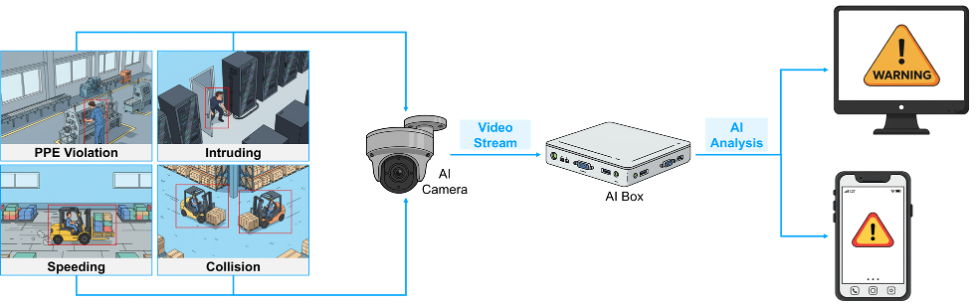
From AI Assistant to Autonomous Agent
Many companies are already deploying foundational AI agents in the form of AI-powered assistants. A solution like TMA's factory assistant, found within its sCMMS, demonstrates this evolution. It already allows users to perform tasks using natural language, such as "check equipment status" or “generate a maintenance report.”
This is a powerful semi-autonomous agent. The next logical step, and the one leading manufacturers are now taking, is to remove the human prompt. The agent will proactively monitor data from the sCMMS and VMS platforms and independently execute these tasks. It will not wait to be asked; it will act based on its goals—maximizing uptime, ensuring safety, and boosting productivity.
The Future is Autonomous
AI agents represent a fundamental shift from AI as a passive tool to AI as an active collaborator. They are the new digital workforce, capable of managing complex systems with a level of speed and efficiency that humans alone cannot match. While full-scale adoption is still emerging, the organizations that successfully integrate autonomous AI agents into their core platforms will not only optimize their operations but will lead the next wave of industrial innovation.


.webp_2026-10-01-18-27-07-971.webp)
.webp_2026-10-01-18-17-11-290.webp)
.webp_2026-10-01-18-08-26-854.webp)
.webp_2026-10-01-17-47-32-240.webp)